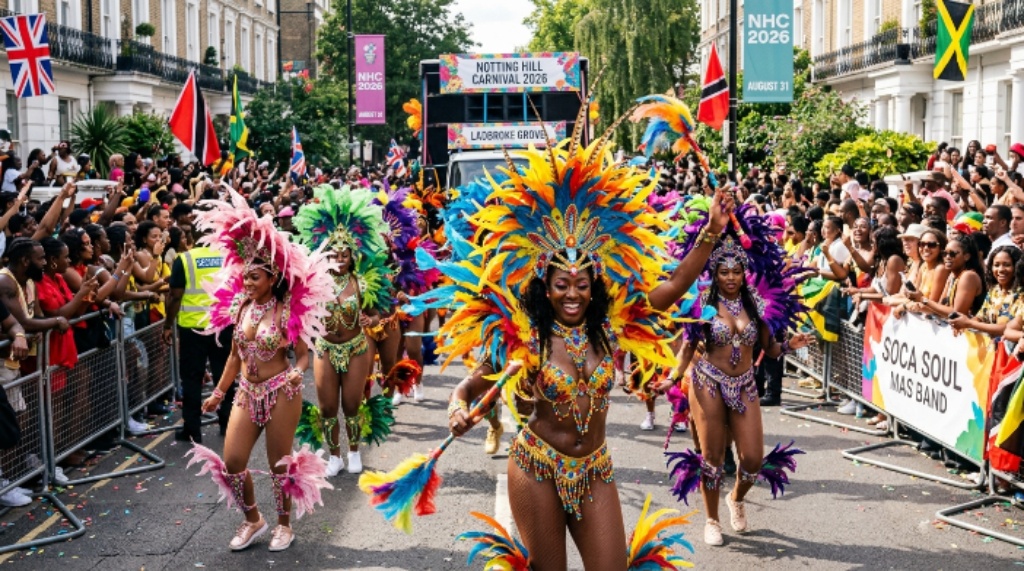
You hear it before you see it. A deep, rolling bass rises from the streets of West London and settles in your chest. Then the colour arrives. Feathers, sequins, and glitter fill the air. Whistles cut through the crowd. Steel pans shimmer in the summer heat. Somewhere nearby, a jerk pit smokes over charcoal, and the whole street smells alive. This is Notting Hill Carnival, and in 2026 it turns sixty years old.
Europe’s largest street festival returns to the streets of West London from August 29 to 31, 2026. This year carries a weight that no previous edition has carried. Six decades since a small community street party in 1966 grew into the world’s second-biggest carnival after Rio de Janeiro, the celebration belongs to everyone who has ever lost themselves in it.
What Is Notting Hill Carnival and Why Does It Matter?
The event began as an indoor celebration organized by Caribbean activist Claudia Jones in 1959. It took to the streets of West London in 1966, inspired by Trinidad and Tobago’s pre-Lenten festivals. The outdoor carnival was co-founded by Rhaune Laslett and others connected to the London Free School, who threw a street party that drew around 500 people. Today, over two million visitors pour into the same streets every August Bank Holiday weekend.
The event is rooted in the experiences of London’s Caribbean community. It celebrates the contribution of that community to British life, culture, and identity through music, movement, costume, and food. Additionally, it has evolved into a truly multicultural gathering that attracts visitors from across the UK and from dozens of countries worldwide. However, its heart remains firmly in the Caribbean traditions that gave it life.
The 60th anniversary in 2026 makes this edition especially significant. Expect special commemorative themes, tribute performances, and programming that reflects on six decades of carnival heritage. Utopia Mas UK has already announced its 2026 theme as “Heart and Soul,” described as a tribute to the carnival’s origins and to the 64th independence anniversary of Trinidad and Tobago.
Full Weekend Schedule at a Glance
| Date | Day | Key Events | Admission |
| Saturday 29 August | Panorama Steel Band Competition Day | UK National Panorama Steel Band Competition at Emslie Horniman’s Pleasance Park, 6 pm to 11 pm | Ticketed |
| Sunday 30 August | Families and Children’s Day | J’ouvert from 6 am to 9 am, Children’s Parade from 10:30 am, Adults’ Dutty Mas, Judging Zone, live music stages | Free |
| Monday 31 August | Adults’ Day – Main Carnival | Adults’ Parade from 10:30 am to 8:30 pm, sound systems, live music, Judging Zone, food stalls | Free |
Saturday 29 August: The Steel Pan Showdown
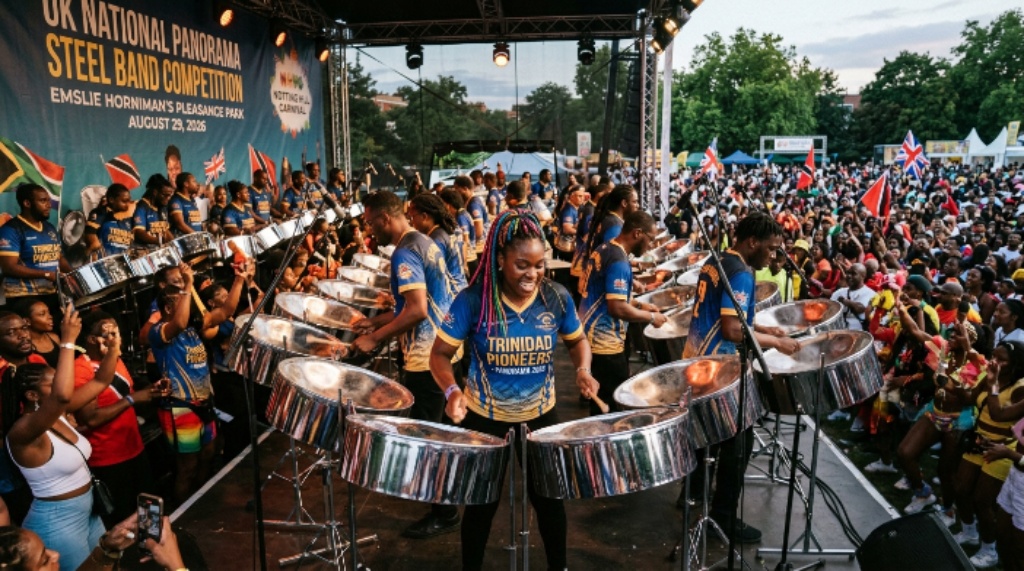
The weekend opens with one of the most electrifying competitions in British music. The UK National Panorama Steel Band Competition takes place at Emslie Horniman’s Pleasance Park from 6 pm to 11 pm. Steel bands from across the country compete to be crowned champion in a high-energy celebration of pan music that is as much a cultural ritual as it is a contest.
This is the only ticketed event of the three days. For anyone passionate about Caribbean music, it is essential viewing. The acoustics of a full steel band performing live at full power is an experience that recorded audio simply cannot replicate. Tickets are available through the official Notting Hill Carnival website at nhcarnival.org.
Sunday 30 August: J’ouvert, Children’s Parade and the Mas Tradition
Sunday is officially Families and Children’s Day, though it packs in more events than most festivals manage across an entire weekend. Entry to all street events is free.
J’ouvert begins before dawn at 6 am, a traditional early-morning street celebration filled with music, movement, paint, and powder. It is loud, joyful, and deliberately free-spirited. Arriving early for J’ouvert means experiencing the carnival at its most raw and communal.
The Children’s Parade begins at 10:30 am and runs through the afternoon. Young masqueraders in elaborate costumes take the parade route, backed by music trucks and surrounded by dancing families. This is the most accessible and family-friendly moment of the entire weekend, and it is genuinely moving to watch the next generation carry the mas tradition forward.
Later on Sunday, adult masquerade bands begin their Dutty Mas presentations along the route, and the Judging Zone comes alive. Live music stages at Emslie Horniman’s Pleasance Park and Powis Square host top DJs, musicians, and surprise guests throughout the afternoon and evening.
Monday 31 August: The Main Parade and the Heart of Carnival
Monday is the biggest, loudest, and most spectacular day of the entire weekend. The Adults’ Parade runs from 10:30 am to 8:30 pm, drawing dozens of mas bands through a 3.5-mile route through the streets of Notting Hill and Ladbroke Grove.
The parade route follows Chepstow Road, continues along Westbourne Grove and Great Western Road, turns through Ladbroke Grove, and returns via Kensal Road. The most dramatic viewing spots sit at the junction of Ladbroke Grove and Westbourne Grove, and at the bend near the Westway overpass, where the largest bands perform their set pieces for the crowds and cameras.
Each mas band brings its own costume theme, its own music truck, and its own team of dancers. The costumes are extraordinary works of art. Enormous feathered headdresses, sequined bodysuits, and fantastical designs that can take months to create fill the street in every direction. The soca, calypso, and steel band music that drives the parade is relentless and celebratory in equal measure.
If you can only attend one day, Monday is the one to choose.
The Sound Systems: The Heartbeat of the Street
More than 35 static sound systems are positioned along the carnival route throughout Sunday and Monday. Each plays a different genre, which means the experience shifts dramatically as you move through different sections of the route. You walk from soca to reggae to dancehall to UK garage to drum and bass without leaving the street.
Some of the most famous sound systems in carnival history have been fixtures at the event for decades. Mangrove is one of the longest-running, specializing in soca and calypso. The sound systems are not simply speakers on a corner. They are community institutions with their own loyal followings, their own histories, and their own role in the event’s identity.
Therefore, rather than trying to follow the parade for its entire length, many experienced visitors prefer to find a great sound system, settle nearby, and let the carnival come to them.
Caribbean Food and Flavour
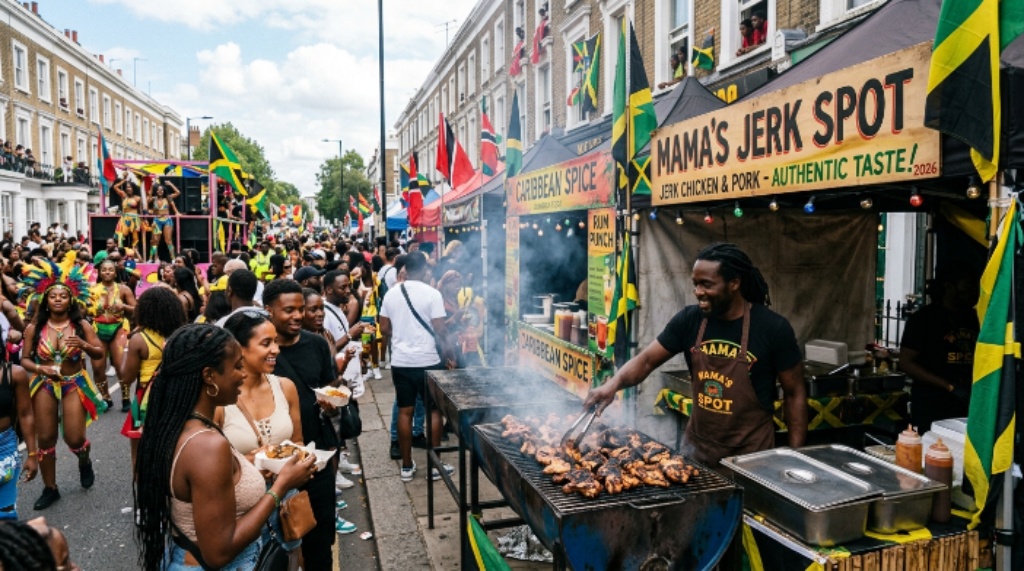
Over 300 food stalls line the parade route throughout the weekend. The food is one of the most celebrated parts of the entire event, and rightly so. The offerings span a wide range of Caribbean culinary traditions, and the quality at the best stalls is genuinely outstanding.
| Dish | Origin | What to Expect |
| Jerk chicken | Jamaica | Slow-grilled over charcoal with scotch bonnet and allspice |
| Curry goat | Jamaica and Trinidad | Tender, slow-cooked, deeply spiced |
| Rice and peas | Jamaica | Kidney beans cooked in coconut milk with rice |
| Trinidadian roti | Trinidad and Tobago | Flatbread wraps filled with curried vegetables or meat |
| Guyanese pepper pot | Guyana | Rich, slow-cooked meat stew with cassareep |
| Jamaican patties | Jamaica | Flaky pastry filled with spiced beef, chicken, or vegetables |
| Plantain | Pan-Caribbean | Sweet or savory, fried until golden |
| Ackee and saltfish | Jamaica | Jamaica’s national dish, often served on the side |
Arrive hungry. Eat often. Follow the smoke.
Practical Visitor Tips for a Perfect Weekend
The carnival draws over two million people across two main days. A little preparation makes the difference between chaos and one of the best days of your year.
- Arrive early, especially on Monday. The crowds build quickly from mid-morning onward, and popular spots along the route fill up fast.
- Wear comfortable footwear. You will walk several miles across uneven ground and cobblestone streets over the course of the day.
- Dress for the weather and the occasion. Bright colors and Caribbean-inspired clothing are warmly welcomed. Bring layers in case of typical London August rain.
- Travel light and leave valuables at home. Pickpocketing is a known issue at events this large, so carry only what you need.
- Use public transport. Road closures affect a large part of West London, and driving anywhere near the route is not practical. The nearest tube stations are Notting Hill Gate, Ladbroke Grove, Westbourne Park, and Royal Oak. Plan to walk some distance regardless of which station you use.
- Stay hydrated. Water is available from stalls and vendors throughout the route.
- Download the official carnival app or check nhcarnival.org before you go for the most up-to-date route map, sound system locations, and stage times.
- The carnival runs in all weather. There is no rain cancellation policy.
Conclusion
Notting Hill Carnival 2026 runs from August 29 to 31 across the streets of Notting Hill, Ladbroke Grove, Westbourne Grove, and surrounding West London neighborhoods. Saturday brings the ticketed Panorama Steel Band Competition from 6 pm at Emslie Horniman’s Pleasance Park. Sunday offers J’ouvert from 6 am, the free Children’s Parade from 10:30 am, and the first sounds of the mas bands on the route. Monday delivers the full Adults’ Parade from 10:30 am to 8:30 pm, backed by over 35 sound systems and more than 300 food stalls. This year holds an extra layer of meaning. It marks the 60th anniversary of the outdoor street carnival that began in 1966, making it the most significant edition in a generation. Whether you come for the steel pan competition, the children’s parade, the soca and reggae on the streets, the extraordinary mas costumes, or the jerk chicken smoke drifting through Ladbroke Grove, this is one of the greatest free events on earth and 2026 is the year to be there.
Frequently Asked Questions
When is Notting Hill Carnival 2026 and is it free?
The carnival takes place from August 29 to 31, 2026. Saturday August 29 features the Panorama Steel Band Competition, which is a ticketed event running from 6 pm to 11 pm at Emslie Horniman’s Pleasance Park. Sunday August 30 and Monday August 31 are both free public events, with no ticket required for street access.
What is the parade route for the 2026 carnival?
The main parade route runs along Chepstow Road, continues through Westbourne Grove and Great Western Road, turns down Ladbroke Grove, and returns via Kensal Road. The official route map for 2026 will be published closer to the event on the official website at nhcarnival.org. The total route covers approximately 3.5 miles.
Why is Notting Hill Carnival 2026 especially significant?
2026 marks the 60th anniversary of the outdoor Notting Hill Carnival, which first took to the streets in 1966. The event grew from a small community street party attended by around 500 people into Europe’s largest street festival, drawing over two million visitors annually. Special 60th anniversary programming, commemorative themes, and tribute performances are expected throughout the weekend.
What food can visitors expect at the carnival?
Over 300 food stalls line the parade route throughout the weekend, offering a wide range of Caribbean dishes. Popular options include Jamaican jerk chicken, curry goat, rice and peas, Trinidadian roti, Guyanese pepper pot, ackee and saltfish, Jamaican patties, and plantain. Drink vendors, ice cream sellers, and other food providers are also distributed along the route.
How should visitors travel to Notting Hill Carnival?
Public transport is strongly recommended. Road closures affect large parts of West London across the carnival weekend, making driving impractical. The nearest tube stations are Notting Hill Gate on the Central and Circle lines, Ladbroke Grove and Westbourne Park on the Hammersmith and City line, and Royal Oak on the same line. Visitors should expect to walk several minutes from whichever station they use, as crowds build throughout the morning on both Sunday and Monday.